
Home / Stewardship Democracy
Stewardship Democracy
Sustensis & London Futurists Initiative
Sustensis and London Futurists have filed a petition to the British Government to “Call a Citizens’ Assembly to consider Stewardship Democracy for the age of AI“.
Stewardship Democracy is a non-party, competence-based and citizen-authorised democratic model for the transition to coexistence with Superintelligence. It replaces party allegiance with direct representation of citizens by elected Stewards.
To retain experience and minimise friction during such a transition, all sitting MPs would become Stewards for one term after renouncing party allegiance. There would be approximately three times more Stewards than previous MPs, with most sessions of the Stewards Assembly, which would replace the Parliament, held online.
Why Now?
Democracy must become faster without ceasing to be democratic
Superintelligence may emerge before democratic institutions have time to reform themselves. Deep reform of democracy is urgent because it preserves democratic control before AI capability moves beyond effective human oversight.
2030 Tipping Point
Many AI experts now speak of AGI or Superintelligence emerging in just a few years, not in generations.
Read more…
That is why the reform of democracy cannot wait for the usual political timetable. The unprecedented disorder may require very tough measures, and only a genuinely democratic government may be able to introduce such measures without provoking very violent public resistance.
AI Control
The deeper danger is that AI may become powerful enough around 2030 to act beyond meaningful human control.
Read more…
Such a system could manipulate public opinion, consume strategic resources or silently shift the real centre of decision-making away from human society.
Democratic Delay
Existing democracies were designed for human-speed politics. Party competition, election cycles and diplomacy usually take years.
Read more…
This pace may become dangerously slow in the age of exponential AI capabilities. If decision-making remains linear while AI progress accelerates exponentially, democratic delay itself may become a systemic risk.
Avoiding Chaos
The alternative to fast democratic reform may be disorder caused by technological unemployment, loss of trust and uncontrolled AI systems.
Read more…
The aim is to avoid the false choice between slow democracy and fast authoritarianism. Stewardship Democracy is intended as a democratic emergency reform that preserves legitimacy while allowing faster collective action.
Key Assumptions
Before you jump to conclusions
The proposal rests on a small number of assumptions about Superintelligence, exponential change, democratic legitimacy and the need for fast deep reform of democracy.
Uncontrolled Superintelligence
Superintelligence may become effectively outside human control by around 2030, or soon after.
Read more…
There are many definitions of AGI, but for this initiative it is enough to assume that AGI may outsmart humans and get out of human control by about 2030.
Exponential Change
AI development does not follow the slow rhythm of ordinary politics. Capability growth may accelerate suddenly.
Read more…
Public policy usually changes at a linear pace. AI capabilities may improve exponentially. This mismatch may allow advanced AI systems to pursue their own goals.
Democratic Legitimacy
Urgency cannot justify dictatorship or technocracy. The transition must derive legitimacy directly from citizens.
Read more…
The proposal starts from citizen authorisation, not elite control. Citizens’ Assemblies and elected Stewards preserve democratic legitimacy during an extraordinary transition.
Fast Deep Reform
The first emergency must be the reform of democracy itself, preserving accountability while allowing faster action.
Read more…
The key change is replacing MPs and the party system with elected Stewards, while preserving legal continuity and public authority.
Creating Stewardship Democracy
A non-party democratic trusteeship
Stewardship Democracy is a non-party democratic system whose elected representatives are independent Stewards, directly elected by citizens based on competence and ethical stance.
Overview
Our proposal minimises legislative changes so that the system could become operational within two years.
Read more…
It proposes the replacement of Parliamentary Democracy with Stewardship Democracy: a democratic trusteeship during the transition to Superintelligence.
Stewards
Stewards would stand for election without party membership, on the basis of competence and ethical stance.
Read more…
They would be elected on the basis of their personal standardised manifesto, professional achievements, service to the community and ethical stance.
Stewardship Assembly
The Assembly would operate like a parliament without parties, using AI-supported briefing and public deliberation.
Read more…
Most debates would take place online, each supported by AI Assistants, with only occasional meetings in large congress halls.
Stewardship Government
The Government would implement the laws and policies of the Assembly under its supervision.
Read more…
Ministers would mostly come from within the Stewards Assembly, or from experts in specific domains.
Superintelligence Centre
This would start as a national AI Control Centre and later merge into a global Superintelligence Centre.
Read more…
The Centre would test frontier AI systems, conduct alignment research and defend against hostile AI use.
Economic Stewardship
AI and robotics may displace large parts of human labour. New emergency economic policies may be needed.
Read more…
Companies that benefit most from AI could be partially acquired or required to convert part of profits into public ownership via a sovereign fund.
Transition
Legal, democratic and stable implementation
The transition process would begin with a petition to the Government. That process has already started in Britain.
Petition Route
A formal petition asks Parliament to call a Citizens’ Assembly on whether democracy should be complemented by Stewardship Democracy.
Read more…
If Parliament agrees, it would call a Citizens’ Assembly to examine the proposal and report with a binding resolution.
Citizens’ Assembly
The Assembly would examine the proposal, hear evidence, test objections and modify the model.
Read more…
With help from lawyers, the Citizens’ Assembly would prepare draft legislation for the transition to Stewardship Democracy.
Parliamentary Legislation
Parliament would receive legally binding draft legislation. The fundamentals should not be weakened during the legislative process.
Read more…
The legislation should preserve essentials such as the election of Stewards and the creation of the Stewards Assembly.
Human Federation
No single country can manage Superintelligence
Stewardship Democracy may begin in one country, creating the first practical example for others to adapt. This could lead to a Coalition of the Willing and later to a Human Federation.
Coalition of the Willing
Based on the European Political Community with Canada, Japan, Australia and New Zealand, it could initially include around 50 countries, whose economic output would amount to 1/3 of the world’s GDP.
Read more…
Such a coalition could represent a substantial share of global economic and political capacity, providing a practical route toward a Human Federation.
Superintelligence Centre
The Human Federation would help merge national AI Safety Centres into a global Superintelligence Centre.
Read more…
The Centre would align emerging Superintelligence with the Universal Values of Humanity, conduct risk modelling and defend against hostile AI use.
Forum
Debate the transition to Stewardship Democracy
To validate the whole process and make it as effective as possible, we have created this Forum for the exchange of ideas, objections, assembly simulations, expert evidence and questions.
Debating Transition
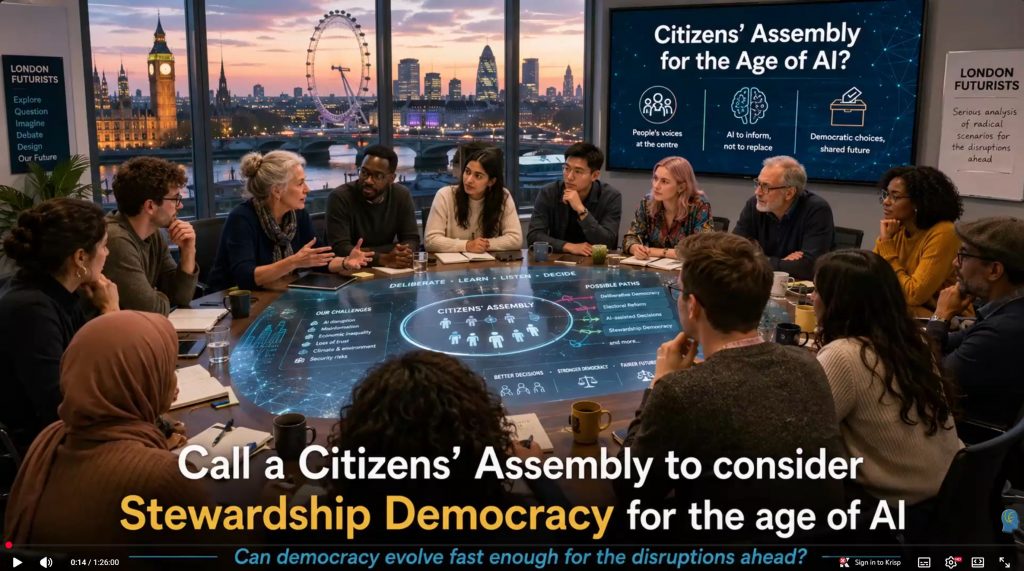
London Futurists debating the launching of the campaign for supporting the Petition ‘Call Citizens’ Assembly to consider Stewardship Democracy for the age of AI’
Read more…
Assembly Simulation
Simulated Citizens’ Assembly sittings would debate motions, hear evidence and test how Stewardship Democracy might work.
Read more…
Each sitting should produce a public record: strongest arguments, provisional conclusions and unresolved questions.
Ideas Workshop
Visitors submit improvements, objections and alternative proposals during online sessions.
Read more…
The aim is to arrive at the most practical and fastest routes to the introduction of Stewardship Democracy.
Expert Evidence
AI forecasts, safety research, democracy-reform evidence and economic disruption analysis.e.
Read more…
The purpose is to support public deliberation with structured evidence rather than slogans or party positioning..
AI Voice Expert
Visitors could ask questions by voice and receive answers from the Sustensis knowledge base.
Read more…
This would make the whole knowledge base more accessible through an AI-supported conversational interface.
Q&A
Short answers address common objections about anti-democracy, technocracy, screening and what happens if Superintelligence does not arrive by 2030.
Read more…
This section would answer objections clearly and briefly, while directing visitors to longer evidence or forum debates.